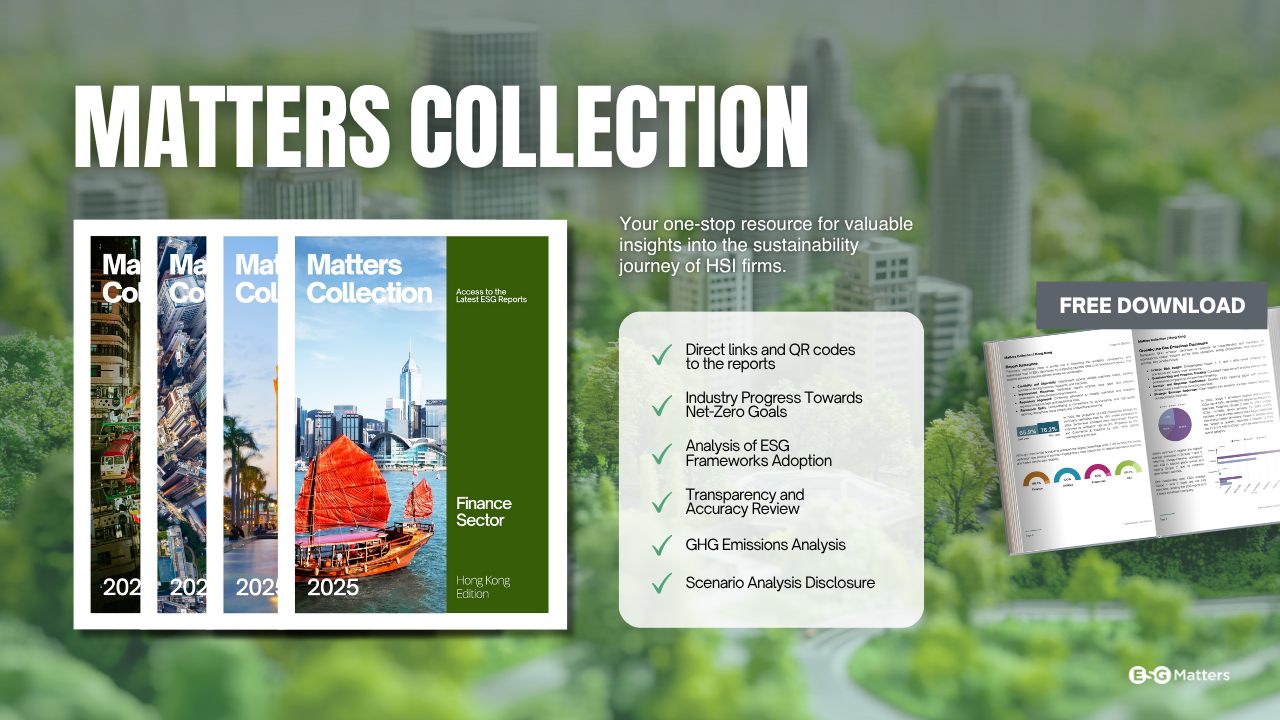
In October 2025, ESG Matters released its latest Matters Collection, offering a comprehensive analysis of the Hang Seng Index (HSI) and the evolving landscape of ESG disclosures among Hong Kong's listed companies. This year's report presents key insights into sector distributions, Net-Zero commitments, reporting framework adoption, verification practices, greenhouse gas emissions disclosures, and the use of scenario analysis.
Sector Distribution within the Hang Seng Index
The 2025 Matters Collection reveals a significant distribution of companies across various sectors within the HSI. The Commercial & Industrial (C&I) sector continues to dominate, reflecting a modest increase in its share compared to the previous year. However, one company in this sector has not yet published its ESG report.
The Finance and Utilities sectors maintain stability, while the Properties sector has seen a slight decline in representation. This analysis underscores the importance of sector-specific trends as companies navigate their ESG commitments.
Net-Zero Commitments: Progress and Challenges
A noteworthy trend is the number of companies setting Net-Zero target years aligned with the HKSAR government's climate goals. Many companies are making strides toward these targets, though some have set goals beyond the government’s benchmarks. The Utilities and Finance sectors display strong commitment levels, while the C&I and Properties sectors also show significant engagement.

Despite this progress, a slight decrease in the total number of pledged companies has been observed, highlighting the need for ongoing dedication to Net-Zero commitments and improved reporting practices.
Reporting Frameworks: Adoption Trends
Scenario Analysis: Strategic Planning for the Future
Reporting Frameworks: Adoption Trends
All HSI-listed companies are required to report under the Hong Kong Stock Exchange (HKEx) framework. Nevertheless, the actual adoption rate falls slightly short of full compliance due to one company not publishing its ESG report.
Among voluntary frameworks, ISO stands out as the most widely adopted, supporting consistent data management and performance tracking across sectors. In contrast, the International Integrated Reporting Council (IIRC) framework remains the least adopted, reflecting limited relevance in certain industries.
The increasing use of multiple frameworks indicates a trend among companies to enhance investor communication and improve climate-related risk disclosures. In anticipation of forthcoming regulatory changes, many companies are integrating best practices into their ESG reports.
Verification Practices: Enhancing Credibility
Verification Practices: Enhancing Credibility
Third-party verification plays a crucial role in enhancing the credibility and transparency of ESG disclosures. The proportion of ESG disclosures backed by independent verification has risen significantly this year. Sector-level improvements have been noted, particularly in Finance and Properties, while the C&I sector still has opportunities for enhancement in its verification practices.
This trend towards greater assurance indicates a commitment to accountability and trust-building with stakeholders.
Greenhouse Gas Emissions Disclosure: A Critical Overview
Transparent disclosure of greenhouse gas (GHG) emissions is essential for managing an organisation’s carbon footprint. Scope 1 emissions remain the largest contributor to corporate footprints, with increases also noted in Scope 2 emissions. The data reveals a notable rise in Scope 3 emissions, which remains crucial for understanding overall environmental impact.
Utilities continue to have the highest average emissions, while the C&I sector leads in Scope 2 due to extensive downstream activities. The importance of robust Scope 3 reporting is emphasised, as many companies still face challenges in quantifying these indirect emissions.
Scenario Analysis: Strategic Planning for the Future
Scenario analysis serves as a vital tool for assessing potential risks and opportunities arising from climate-related factors. A significant number of companies across various sectors are now performing formal scenario exercises, indicating a proactive approach to risk management. The commonly modeled pathways include both 1.5 °C and 2°C scenarios, reflecting a commitment to understanding future climate impacts.
A Path Forward
The 2025 Matters Collection highlights important advancements in ESG disclosures among Hong Kong's listed companies, revealing both progress and areas for improvement. As companies navigate the evolving landscape of climate disclosures, the commitment to transparency, accountability, and continuous improvement will be essential for achieving a more sustainable future.
For further insights and a comprehensive breakdown of these trends, download the full 2025 Matters Collection.
Free Download!
Matters Collection by ESG Matters provides easy access and analysis to the latest annual ESG reports published by firms across four main sectors listed in the Hang Seng index.
The collection contains an array of the latest Environmental, Social, Governance (ESG), Corporate Social Responsibility (CSR) and Sustainability reports.